Showing posts with label Philadelphia Inquirer. Show all posts

Thursday, August 28, 2014

Tommy Conwell and the Little Kings - 1997 Philly Inquirer Review


Tommy Conwell and the Little Kings are featured on the Philadelphia Inquirer’s Lifestyle and Entertainment Magazine section with a review of new release, Sho’ Gone Crazy! on Monday, September 8, 1997. 

Read the review by music journalist Tom Moon: 

Tommy Conwell and the Little Kings - Sho’ Gone Crazy! (Llist Records - 3½ stars): 
After more than a decade providing audiences with rousing live-music experiences, Tommy Conwell has at last made a record that documents his madcap sense of rock and roll and love for the blues. Conwell plays guitar you can get stung by, and here unleashes a stream of disarmingly nonchalant riffage – on the swinging instrumental Moanin’ and the anarchistic jump Pony Time – whose flexibility and concision shame most guitar-mag poster boys. Though Sho’ Gone Crazy! is full of basic 12-bar blues and rockabilly, it’s never tedious. Sounding as if he’s simply got to rock the house, Conwell invigorates music that provides him with an obvious life energy.
~ Tom Moon

Friday, August 9, 2013

A Rumble of Rock and Blues: Tommy Conwell and the Young Rumblers Major-label Debut

Celebrating the 25th anniversary of the release of Tommy Conwell and the Young Rumblers' Rumble. [July 9 - August 9]


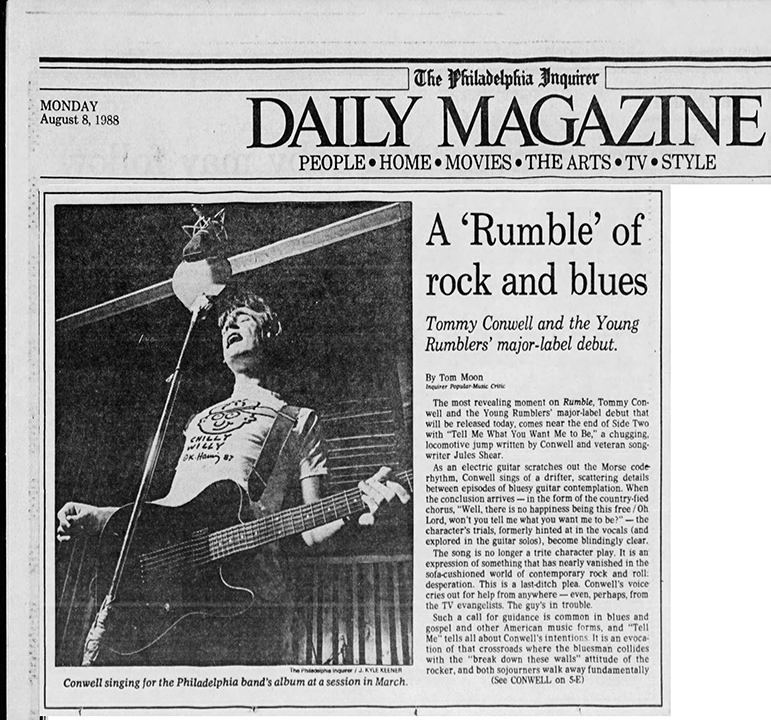
A 'Rumble' of Rock and Blues

Tommy Conwell and the Young Rumblers' major-label debut

by Tom Moon
Inquirer Popular-Music Critic

(Philadelphia Inquirer - August 8, 1988)

The most revealing moment on
Rumble, Tommy Conwell and the Young Rumblers' major-label debut that will be released today, comes near the end of Side Two with "Tell Me What You Want Me To Be," a chugging, locomotive jump written by Conwell and veteran songwriter Jules Shear.

As an electric guitar scratches out the Morse code rhythm, Conwell sings of a drifter, scattering details between episodes of bluesy guitar contemplation. When the conclusion arrives -- in the form of the country-fied chorus:


"Well, there is no happiness being this free \
Oh Lord, won't you tell me what you want me to be?" 

-- the character's trials, formerly hinted at in the vocals (and explored in the guitar solos), become blindingly clear.

The song is no longer a trite character play. It is an expression of something that has nearly vanished in the sofa-cushioned world of contemporary rock and roll: desperation. This is a last-ditch plea. Conwell's voice cries out for help from anywhere -- even, perhaps, from the TV evangelists. The guy's in trouble.

Such a call for guidance is common in blues and gospel and other American music forms, and "Tell Me..." tells all about Conwell's intentions. It is an evocation of that crossroads where the bluesman collides with the "break down these walls" attitude of the rocker, and both sojourners walk away fundamentally changed.

That kind of collision happens all over
Rumble, with varying degrees of success. Conwell and his band, a Philadelphia institution since shortly after its formation in 1984, have earned a reputation playing music that channeled the raw emotion of rock through a more refined understanding of the blues and gospel.

Subscribers to the "sweat first, message later" school, this band has made a record like few in recent memory. Rumble, on Colulmbia, is a real rock-and-roll record, but not a ponderous one. It's hooky, but not gushy. It's direct, but not blunt. It's cocky, but not pretentious.

Unlike other blues-derivative bands that have won success walking these fine lines -- the Fabulous Thunderbirds, for example -- the Rumblers take the rock side of the mix seriously. Conwell has the look of a budding teen idol. The band oozes attitude -- in the grooves, where it counts, not (as yet) in the marketing campaign, the way many budding metal bands do.

Some of the familiar originals have titles like "Walkin' on the Water." As performed on the new album, they contain the strident backing vocals and crunching guitars found more often on rock epics than the blues.

But on Rumble, even the most frothy pop has twinges of blues sensibility. Shear's "If We Never Meet Again" sounds at first like a soft-strumming-acoustic-guitar pop song in the mold of the Eagles. Conwell, going against what is expected, complements his chiming vocals with melodic, occasionally weeping lines of slide guitar that give the love lyrics a regretful spin.

These touches are everywhere: The four-measure instrumental segments that interrupt the verses of Love's On Fire contain evidence of Conwell's ear for knotty, fresh-sounding lead lines. Likewise, the conversation between Conwell's voice and his guitar on the interlude of Gonna Breakdown reveals the guitarist to be a student of the blues-rock of the mid-'60's, one capable of translating those riffs into a decidedly contemporary setting.

Longtime fans of the band will note considerable development since the independently produced 1986 LP Walkin' On the Water, which sold 70,000 copies in regional release. Four songs from that effort -- the single I'm Not Your Man and "Love's On Fire," "Walkin' on the Water" and "Everything They Say is True" -- come off sweet rather than sour. In addition, he has become a more confident vocal personality: He can adopt an ice-cold sneer or a bluesman's growl effortlessly, without apologizing for the new-found assertiveness.

The Rumblers have developed as well. Keyboardist Rob Miller, who joined the band just before the Walkin' sessions, contributes percolating organ chords that are integral to the intensity of almost every song. Paul Slivka and Jim Hannum, the bass-drums team, know instinctively when to dig in and when to evaporate; their interplay gives Conwell lots of room to emote, and the songs a necessary structure.

In live performance, Conwell and the Rumblers have long adapted a simplicity of presentation that comes from blues and early rock and roll. The production of Rumble, handled by veteran Rick Chertoff (Cyndi Lauper, The Hooters), had to capture that in the studio, and did. Chertoff is professionally invisible in the mix, committed to getting the sound of the band rather than the sound of him producing the band, a common production trip.

That makes Rumble more lively than man-rock albums -- it exhibits a live-performance energy and a cohesiveness that often gets lost on other records under layers of needless padding. The only flaw: While the guitar tracks are slap-you-in-the-face close, there are moments when Conwell's guitar should be allowed to stretch. Chertoff, perhaps mindful of the hit-singles potential of some of these songs, might have clipped the engaging guitarist too close to the vest in a few spots, denying Rumble's audience the chance to experience an inventive guitar voice.

Then again, listen to the three blues choruses Conwell blisters on "Workout," and recall the words of one of his idols, the jazz saxophonist Charlie Parker: "If you can't say what you have to say in three choruses, you can't say it." 


On that solo and throughout the Rumble, Conwell says exactly what he sets out to say.

Tuesday, July 30, 2013

Tommy Conwell Plays Theater Of Living Arts [ March 23, 1989 ]

Celebrating the 25th anniversary of the release of Tommy Conwell and the Young Rumblers' Rumble. [July 9 - August 9] 

Tommy Conwell Plays Theater Of the Living Arts
March 23, 1989
By Tom Moon
Philadelphia Inquirer Popular Music Critic


To some longtime followers of rocker Tommy Conwell, the first verse of his new song "Play Your Music," which he premiered last night at the Theater of Living Arts, probably sounded autobiographical: 

"Why do they gotta change him, and take away the beauty of his song, and make him look out of place?" 

...the young rocker wondered, musing on the star-making machinery that has kept him working (and highly visible) since the release of his debut album, Rumble, last fall.

His conclusion, then and all night long: Play your music. In this case it was a brawling, Rolling Stones-style backbeat. Later it was the blues, explored with confidence and a knowing familiarity you can't learn from method books. Still later, it was the assertive Philadelphia-style rock-and-roll of his originals "Love's On Fire" and "Gonna Breakdown."


Performing the first of eight sold-out shows at the intimate South Street theater, Conwell and the Young Rumblers traded the gloss of the record for the true grit of anything-can-happen performance. In dramatic, far-flung stage dancing, Conwell stumbled more than once. But his musical miscues were few, and the energy he communicated was more than enough to compensate. It was as if he were admitting to a bit of sweetening in the studio, and atoning for it with an extra helping of spice.

The well-paced show included a few new selections - with "Play Your Music" among the strongest - but concentrated on material from Rumble. ''Walkin' On the Water" became a fluid celebration stung by darts from Conwell's guitar. "If We Never Meet Again" found Conwell tempering the hope of the lyric with a strong shot of bitterness. Even the snappy "Everything They Say Is True" benefited from the live setting's spaciousness.


Throughout the 90-minute show, the Young Rumblers - Jim Hannum, Rob Miller, Paul Slivka and Chris Day - pumped out lean, supportive backing. Guitarist Day sparked a two-guitar duel with Conwell on the blues "Workout," and turned in solos that equaled the leader's in fiestiness. Even during Conwell's extended foray into the crowd, which found him straddling rows and straining to keep his balance, the band shadowed his musical moves, responding to slight changes in volume level or tempo.

Decked in a Bird Lives T-shirt and stretch jeans, Conwell commanded most of the attention, however. He paid tribute to his influences - with blues choruses lifted from Muddy Waters and traces of "Salt Peanuts" and other jazz melodies sprinkled through his solos - and yet managed to retain and develop his own snarling personality. Sometimes he'd play everything he could, a flurry of notes that defied comprehension. At other times he'd find a particularly resonant tone and, following blues tradition, milk it for every drop of excitement. 

Encore performances included "I Want to Make You Happy" and a version of the Rolling Stones' "Hand of Fate."

As Conwell himself said after premiering "Play Your Music,"..."not too shabby." Not shabby at all.

Thursday, July 11, 2013

Tommy Conwell Heads Chestnut Cabaret Bill - 1987

Celebrating the 25th anniversary of the release of Tommy Conwell and the Young Rumblers' Rumble. [July 9 - August 9]


A 1987 article from the Philadelphia Inquirer talks about Tommy Conwell and the Rumblers performing at the Chestnut Cabaret and getting ready to go into the studio to record RUMBLE for Columbia.
Tommy Conwell Heads Chestnut Cabaret Bill
October 9, 1987 | By David Hiltbrand, Special to The Inquirer
Tommy Conwell and the Young Rumblers are at the Chestnut Cabaret tomorrow night with Dynagroove. Next month, Conwell goes into the studio to record his debut album for Columbia. It will be produced by Rick Chertoff and contains songs from his locally released album, Walkin’ on the Water. Sound familiar? It's the blueprint from the Hooters' path to stardom. The result should be about the same for Conwell, a smoking performer who combines the intensity of pub rocker Graham Parker with a deft pop touch and a great guitar style on his hollow-body Guild.

Source: Philadelphia Inquirer Archives

Monday, August 6, 2012

Teacher's Skills Are As Solid As Rock


Philadelphia Inquirer | October 18, 1997
By Daniel Rubin

It's a glorious Friday afternoon, and the twenty-four third graders return from recess like Superballs shot from a cannon. They can't sit still for spelling. Social studies seems hopeless. The rookie teacher turns to a favorite weapon.

"OK, folks,"' says the gravel-voiced man in a buzz cut and rep tie, "it's time for Multiplication Rock." When the cheers die down, he has one foot on a desk, balancing a second-hand guitar he bought for such moments. The class starts chirping in unison math facts buried painlessly in the catchy tune.

"Two times two is four. Two times three is six." The teacher stays in the background, but he can't help throwing in a tasty chord or lick.
The third graders at Enfield Elementary have former rock star Tommy Conwell for their teacher.

He's Mr. Conwell these days - a 35-year-old beginner, and the Springfield, Montgomery County, school's only male classroom teacher. On weekends, he can be found playing around town with his band, the Little Kings. Weeknight gigs are a thing of the past. So are limousines.

Ten years ago, New York record-company execs were lined up outside his shows at the 23 East Cabaret in Ardmore, checkbooks in hand, hoping to throw money at the lanky blond rocker and local guitar hero.

"Conwell is all attitude,'' wrote an Inquirer reporter in 1987, "black boots, spiked hair, Billy Idol sneer, snarling guitar.'' He was also described as unfailingly polite, patiently signing autographs and drawing cartoons for fans, his respectfulness ingrained by the nuns of Bala Cynwyd.

Columbia Records reeled in Tommy Conwell and his Young Rumblers for big bucks, and they made two albums. Eventually, Conwell realized he was more of a performer than the songwriter the labels were looking for.

After MCA, his last big record company, dropped him four years ago, he thought about his prospects and decided that the money he had saved would allow him to go back to school full time. Last December, he graduated from Chestnut Hill College, where he was used to being the only guy in the room.

Now he's the only adult in a room full of 7-, 8- and 9-year-olds who have to raise their hands to go to the bathroom. The kids don't remember his salad days, but their parents do.

"The first thing their parents tell me is, 'I saw you at the Cabaret,'" says Conwell, who lives in Chestnut Hill and has a 3-year-old son. If he wanted some compartmentalization in his life, events conspired against him: On the first Monday of the term, his latest record - Sho' Gone Crazy! - got reviewed in the paper.

"The word gets around,'' he says. "Some of the parents are my age. When I first dreamed about being a teacher, I knew having a rock-and-roll past might be a positive or a negative. Some just might not like it. If that happens, then I'll have to convince them."


Screenshot from PRISM interview [Tommy Conwell and the Little Kings Live at the Chameleon, 1997.

His blond hair is now shorn to a dark nub he rubsconstantly as he decides which way to go with his students. He always wears a tie. Usually he's in a suit - "makes me look more like a principal,"' he says, cracking up. 

Some of the lessons from the music world have helped the novice teacher, who student-taught at Enfield last year. For social studies, he had his pupils write a song about Johnny Appleseed, sung to the tune of The Star-Spangled Banner. They made up one about Miss Rumphius - a character in a Barbara Cooney book - to the tune of Barbara Ann. 

Conwell's class is known around school as the one that gets to do the most singing. 

"I wish I could have him again next year,"' says Edgett Hilimire, 9, who was wearing a jacket and tie yesterday, like his teacher. The boy was also wearing punkish red nail polish. ("I love this kid," Conwell says.) 

"I've never really had a boy teacher before,"' says Emily Walker, 8. "It's sort of neat. It's sort of funner." 

Principal Warren Mata knew nothing of Conwell's roots when they met last year. Mata knew only that during the interview, Conwell handled every question designed to plumb his knowledge and resourcefulness. 

"He was incredibly prepared to be a teacher," says Mata, 42,who lived in Montana and North Jersey during Conwell's 1980s rise. "I wasn't here during the rock-star era of his life. To me, he's not that person. He's a person who has come well-equipped."' 

There is barely an inch of white space on the walls of Mr. Conwell's room, the surfaces covered by posters and drawings, lists and instructions. Step two in The Writing Zone tells how to make a draft: "Write a messy copy." 

The guitar stands in one corner, an upright piano in another with sheet music for "High Hopes'' and "Swinging on a Star.'' Against the far wall, Conwell has built a stage, with shimmering green curtains from his days on the road. 

Over the blackboard a bright sign says "Showtime." And over that: "You never know what you can do until you try." 

"It's great," says Conwell. "It's a great age and I'm very much in love with the kids. I'm just nuts about them. It makes it easy to come here every day. It makes it easy to work hard. The hours I'm putting in are just more than I would ever imagine, but it's not drudgery. It's inspired work. Your heart is in it. My heart is in it." 

He laughs as he says this. "I must say, I'm still a rookie, so I'm figuring it all out. And there's a lot to figure out." 

The real challenge, he says, is directing all the energy and ability levels he finds in one room. "As a musician, my biggest job has been to create excitement in the audience. Here, this is not the primary goal." He laughs again. 

"I have to manage kids' moods - there's a wide dynamic range. And there are times, many times, when everyone needs to be silent. Managing that is a trick." 

The way he greets his young rumblers after their midday recess suggests he's not having any jitters. 

"We don't shout. We enter quickly. We don't talk right now. Take a seat. Put your desk in position for a test. Take out your spelling notebooks," says the man whose diploma - posted by the door - reads Thomas Edward Conwell, bachelor of science. "We have work to do."

Saturday, March 17, 2007

Tommy Conwell - Philadelphia Inquirer Article

Part of the Audio Rumble collection includes a partial (untitled) article from the Philadelphia Inquirer's Nicole Pensiero.

"....Jersey shore to the college campuses of Philadelphia and Delaware, Conwell is making his mark.

He knows it will take more than a good promoter and optimism for him to reach his goal. Yet he thrives on the struggle: Each step -- such as the recent recording of some original tunes at The Record Plant in New York City -- is a small victory on the road to success.

 
"I remember once in high school I told my mom I wanted to be a musician and she said that she didn't think I was good enough. At that point, I wasn't doing so hot in school and I guess she didn't think I was disciplined enough. Man, that had such an impact on me. It made me more inspired than ever," he recalls. "It's not real wise to say you want to be a musician without something to back it up. You've got to just go out and do it and become one. Then you can say it."

Articulate and polite, Conwell is eager to talk about music and people in the business. He has clear opinions on almost everyone, including himself.

  
"I want to be on MTV and on radio. There's no reason whatsoever why I can't do it," Conwell says. He describes himself as a 'Pete Rose' of singers.


"I'll make it with desire, not with vocal prowess. God didn't intend for me to sing, but I'm doing it anyway," he says. "Nothing brings me greater pleasure than being in command of my voice. I have a good feel for music, and it comes out no matter what I do."  

If Conwell seems disarmingly confident -- even about the things that aren't his strong points -- it's because he is. If you work hard and are proud of your work, there's no need for what he calls "false humility."

"I like (Bruce) Springsteen's music, but I don't like the 'Gee, shucks' stuff. He probably is a regular guy, but I get offended by the sentimentality and the corny things he does. When he sits on the stage and tells stories about high school, I'm thinking 'Be real here. He's 35 years old. When was the last time he lived at home?"

In conversation, Conwell's words sometimes can barely keep up with his rapid-fire thoughts. Then, without warning, he'll slow down, shutting his eyes a little, in a sexy offhand way, as he softly breaks into one of his favorite tunes.

Onstage or off, Conwell is someone to watch. 

    
Tonight, this young rumbler is sporting a battle scar from a recent gig -- he smacked himself in the head with his guitar, requiring stitches over his right eye. Anyone who's seen the Rumblers perform...(missing text)
 ...but there's the pretty boy thing, too.

"Whatever is looks like, it looks good," he says matter-of-factly.
    
People in Conwell's hometown speak about him as the boy-next-door, which, in many ways, he still is. They say Conwell deserves to be a full-fledged rock star, not only because his music is good, but because he's willing to work hard for everything he gets.
     
When it comes to rock 'n' roll, Conwell believes attitude is everything. You can't complain about the business because "there's a lot to complain about, (and) once you start, you won't stop."
   
There aren't any free lunches in Conwell's book, either: Musicians need to "be as self-sufficient as anyone else."
    
"Just because you're an artist doesn't mean you have the right to depend on other people for everything. I hate it when I hear about people who never moved out of their folks' house because they can't get their career off the ground."
    
Born and raised in Bala Cynwyd, Pa., Conwell is the youngest of three boys. His brother, Joe, is a professional football player with the Baltimore Stars, and his oldest brother is in the Air Force.
    
He believes he "always had some musical talent" and remembers, as a tyke, picking out tunes like "The Little Drummer Boy" on the piano. But it would be years before Conwell would approach the guitar.
   
"I remember in church they had these folk Masses and there'd be 15 kids playing Kum Ba Ya and it looked hard to me. So I stayed away from it."
   
That changed, though, when Conwell was a teenager and his grandmother presented him with a ukelele, which he says, is very similar to a guitar.

Learning the ukulele got the young Conwell thinking about a career in music. In tenth grade, he casually informed his parents that he wanted to get an electric guitar so he could play with the Lower Merion High School Jazz Band.

"I remember me dad just yelled in this loud voice, "No electric guitars!" We kids just laughed; we knew that would pass."

Conwell was right -- his parents are now his most devoted fans.
   
He scrapped plans to pursue a career as a jazz musician and started directing more and more of his time to rock music when he attended the University of Delaware.

There he played in several bands ranging from blues to punk rock. Conwell's guitar style and dynamic stage presence in a band called Rockett 88 earned a strong local following. Rockett 88 had, as Conwell says, "higher aspirations" than just the bar scene, and he was "attracted to the ambition."
    
.....(missing text) merely folly, as it turned out to be," he says.

Determined to carve a niche for himself in music, Conwell formed the Young Rumblers in February 1984.
   
"At that point, I never entertained the idea of the band being a democracy," he says. "It was my band. It wasn't like I was power hungry -- I just didn't want anyone holding me back. I feel better knowing that if something doesn't work out I won't have anyone to blame but me."

The band's name was inspired by the Link Wray instrumental "Rumble."

"It's just a great tune -- real menacing," Conwell says. "I wanted the 'Young' in the name because I felt wild and energetic and because it stresses an attitude, a rawness. When people say to me 'What about when you get old? Will you still be the Young Rumblers then?' I tell them they're missing the point. I don't plan that far ahead. Getting old is not the point of rock 'n' roll."
    
The Rumblers - who have had three drummers and two bass players since forming -- are "closer to a democracy now than it's ever been," Conwell says. He has nothing but praise for his sidemen, drummer Jim Hannum, 26, and bassist Paul Slivka, 25, who have been with hims since late 1984.
  
Hannum and Slivka, who Conwell knew from his days in Delaware, had played together for 10 years in different bands before becoming Young Rumblers.
    
The band, whose musical style has been compared to the Stray Cats and George Thorogood (one of Conwell's all-time favorites), recently traveled to New York to record some of their most popular songs. One Conwell-penned tune, "Million Pretty Girls" is getting steady airplay on Philadelphia radio stations.

The next step will be to put out a record -- but only when the timing is right.
  
"If the music is good, it doesn't matter when you do it -- you're going to be successful. It's like being a boxer. You have one shot at the title, so you don't pick a fight with the champion until you're trained and ready," he says.

"I think we need to take things as far as they can go before going on to the next thing. I want to take where we are now -- a local band with no record -- as far as we can. Then we'll do some recording, and we'll be a local band with a record. We've got to own Philly first -- then we'll go national," Conwell says smiling. "I can't wait."