Showing posts with label Tom Moon. Show all posts

Wednesday, March 11, 2015

Buzz Zeemer - Critic Reviews [1995 - 1999]

Various Buzz Zeemer critic reviews (Plaything in 1996 and Delusions of Grandeur in 1998) compiled by Audio Rumble from the now defunct Record Cellar website.
"Heavy-hitters ... if the word 'catchy' didn't exist, someone would have to invent it to fully describe these guys."
- Reggie Beehner, University Reporter, 2/96


 "The hook on 'Crush' is so infectious you want to loop it over and over and play it forever."
"...For three minute pop songs there isn't a better songwriter around than Frank Brown..."
- Bruce Warren, Philadelphia Weekly 3/98, 6/96
"Only February, and already we have the local debut album of the year. ...Buzz Zeemer has something most don't -- songs, packed with chugging rhythms, sprightly bridges, and hooks galore."
- Ed Hewitt, Montgomery County Newspaper's Ticket 2/96 
"Frank Brown, the songwriter of Buzz Zeemer, owns a special place among area talents who deserve wider recognition. For nearly a decade, he's improved steadily, honing a personal approach and writing songs far more sophisticated than those of like minded major-label bands. The wry Delusions finds him still plugging away. It's got crisp rock laments, astringent Elvis Costello pop hooks, forays into pure 60's pop, and a few of those galvanizing moments when blind fury crystallizes into something that sounds like wisdom."
- Tom Moon, Philadelphia Inquirer, 1/99
"Frank Brown's power pop anthems just keep getting stronger, especially with Tommy Conwell now riding shotgun on guitar and harmony vocals. As modern and catchy as anything put out by critics' darling Paul Westerberg, ..."
- Jonathan Takiff, Philadelphia Daily News, 1/99
"Another Buzz Zeemer album, another enticing bunch of songs catchier than anything on the radio."
- Dan DeLuca, Philadelphia Inquirer, 12/98
"I'm not sure these guys are delusional; this is a grand record."
- Rick Cornell, Amplifier, Summer/1999 
"Buzz Zeemer's new record, Delusions of Grandeur, is a subversively brilliant pop-rock record... . Brown's innate gift for melody is surpassed by spare lyrics that reveal layers of meaning and emotion not apparent on first listen."
- Phil Sheridan, No Depression, 7/99
"On Delusions of Grandeur, they knock out 12 near classics and make it look so easy."
- Tim Hinely, Surfnews, Summer/1999 
"Delusions of Grandeur is in my top ten for 1999."
- Peter Blackstock, Co-Editor, No Depression, 12/99  
"...Singer and songwriter Frank Brown's tunes come on with a melodic subtlety that keeps bringing you back."
- Dan DeLuca, Philadelphia Inquirer, 2/96 
“…melodic pop-rock band Buzz Zeemer…has stepped up to the most-unjustly unsigned level since adding Tommy Conwell on lead guitar.” Billboard Magazine, “Indie Labels Discover Freedom in Philly” – 10/28/1995

Thursday, August 28, 2014

Tommy Conwell and the Little Kings - 1997 Philly Inquirer Review


Tommy Conwell and the Little Kings are featured on the Philadelphia Inquirer’s Lifestyle and Entertainment Magazine section with a review of new release, Sho’ Gone Crazy! on Monday, September 8, 1997. 

Read the review by music journalist Tom Moon: 

Tommy Conwell and the Little Kings - Sho’ Gone Crazy! (Llist Records - 3½ stars): 
After more than a decade providing audiences with rousing live-music experiences, Tommy Conwell has at last made a record that documents his madcap sense of rock and roll and love for the blues. Conwell plays guitar you can get stung by, and here unleashes a stream of disarmingly nonchalant riffage – on the swinging instrumental Moanin’ and the anarchistic jump Pony Time – whose flexibility and concision shame most guitar-mag poster boys. Though Sho’ Gone Crazy! is full of basic 12-bar blues and rockabilly, it’s never tedious. Sounding as if he’s simply got to rock the house, Conwell invigorates music that provides him with an obvious life energy.
~ Tom Moon

Friday, August 9, 2013

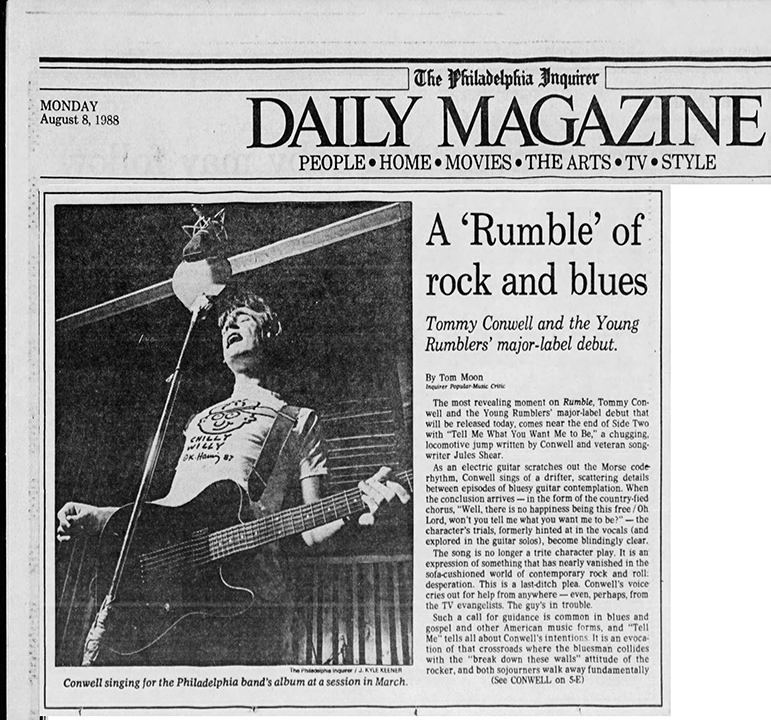
A Rumble of Rock and Blues: Tommy Conwell and the Young Rumblers Major-label Debut

Celebrating the 25th anniversary of the release of Tommy Conwell and the Young Rumblers' Rumble. [July 9 - August 9]


A 'Rumble' of Rock and Blues

Tommy Conwell and the Young Rumblers' major-label debut

by Tom Moon
Inquirer Popular-Music Critic

(Philadelphia Inquirer - August 8, 1988)

The most revealing moment on
Rumble, Tommy Conwell and the Young Rumblers' major-label debut that will be released today, comes near the end of Side Two with "Tell Me What You Want Me To Be," a chugging, locomotive jump written by Conwell and veteran songwriter Jules Shear.

As an electric guitar scratches out the Morse code rhythm, Conwell sings of a drifter, scattering details between episodes of bluesy guitar contemplation. When the conclusion arrives -- in the form of the country-fied chorus:


"Well, there is no happiness being this free \
Oh Lord, won't you tell me what you want me to be?" 

-- the character's trials, formerly hinted at in the vocals (and explored in the guitar solos), become blindingly clear.

The song is no longer a trite character play. It is an expression of something that has nearly vanished in the sofa-cushioned world of contemporary rock and roll: desperation. This is a last-ditch plea. Conwell's voice cries out for help from anywhere -- even, perhaps, from the TV evangelists. The guy's in trouble.

Such a call for guidance is common in blues and gospel and other American music forms, and "Tell Me..." tells all about Conwell's intentions. It is an evocation of that crossroads where the bluesman collides with the "break down these walls" attitude of the rocker, and both sojourners walk away fundamentally changed.

That kind of collision happens all over
Rumble, with varying degrees of success. Conwell and his band, a Philadelphia institution since shortly after its formation in 1984, have earned a reputation playing music that channeled the raw emotion of rock through a more refined understanding of the blues and gospel.

Subscribers to the "sweat first, message later" school, this band has made a record like few in recent memory. Rumble, on Colulmbia, is a real rock-and-roll record, but not a ponderous one. It's hooky, but not gushy. It's direct, but not blunt. It's cocky, but not pretentious.

Unlike other blues-derivative bands that have won success walking these fine lines -- the Fabulous Thunderbirds, for example -- the Rumblers take the rock side of the mix seriously. Conwell has the look of a budding teen idol. The band oozes attitude -- in the grooves, where it counts, not (as yet) in the marketing campaign, the way many budding metal bands do.

Some of the familiar originals have titles like "Walkin' on the Water." As performed on the new album, they contain the strident backing vocals and crunching guitars found more often on rock epics than the blues.

But on Rumble, even the most frothy pop has twinges of blues sensibility. Shear's "If We Never Meet Again" sounds at first like a soft-strumming-acoustic-guitar pop song in the mold of the Eagles. Conwell, going against what is expected, complements his chiming vocals with melodic, occasionally weeping lines of slide guitar that give the love lyrics a regretful spin.

These touches are everywhere: The four-measure instrumental segments that interrupt the verses of Love's On Fire contain evidence of Conwell's ear for knotty, fresh-sounding lead lines. Likewise, the conversation between Conwell's voice and his guitar on the interlude of Gonna Breakdown reveals the guitarist to be a student of the blues-rock of the mid-'60's, one capable of translating those riffs into a decidedly contemporary setting.

Longtime fans of the band will note considerable development since the independently produced 1986 LP Walkin' On the Water, which sold 70,000 copies in regional release. Four songs from that effort -- the single I'm Not Your Man and "Love's On Fire," "Walkin' on the Water" and "Everything They Say is True" -- come off sweet rather than sour. In addition, he has become a more confident vocal personality: He can adopt an ice-cold sneer or a bluesman's growl effortlessly, without apologizing for the new-found assertiveness.

The Rumblers have developed as well. Keyboardist Rob Miller, who joined the band just before the Walkin' sessions, contributes percolating organ chords that are integral to the intensity of almost every song. Paul Slivka and Jim Hannum, the bass-drums team, know instinctively when to dig in and when to evaporate; their interplay gives Conwell lots of room to emote, and the songs a necessary structure.

In live performance, Conwell and the Rumblers have long adapted a simplicity of presentation that comes from blues and early rock and roll. The production of Rumble, handled by veteran Rick Chertoff (Cyndi Lauper, The Hooters), had to capture that in the studio, and did. Chertoff is professionally invisible in the mix, committed to getting the sound of the band rather than the sound of him producing the band, a common production trip.

That makes Rumble more lively than man-rock albums -- it exhibits a live-performance energy and a cohesiveness that often gets lost on other records under layers of needless padding. The only flaw: While the guitar tracks are slap-you-in-the-face close, there are moments when Conwell's guitar should be allowed to stretch. Chertoff, perhaps mindful of the hit-singles potential of some of these songs, might have clipped the engaging guitarist too close to the vest in a few spots, denying Rumble's audience the chance to experience an inventive guitar voice.

Then again, listen to the three blues choruses Conwell blisters on "Workout," and recall the words of one of his idols, the jazz saxophonist Charlie Parker: "If you can't say what you have to say in three choruses, you can't say it." 


On that solo and throughout the Rumble, Conwell says exactly what he sets out to say.

Tuesday, July 30, 2013

Tommy Conwell Plays Theater Of Living Arts [ March 23, 1989 ]

Celebrating the 25th anniversary of the release of Tommy Conwell and the Young Rumblers' Rumble. [July 9 - August 9] 

Tommy Conwell Plays Theater Of the Living Arts
March 23, 1989
By Tom Moon
Philadelphia Inquirer Popular Music Critic


To some longtime followers of rocker Tommy Conwell, the first verse of his new song "Play Your Music," which he premiered last night at the Theater of Living Arts, probably sounded autobiographical: 

"Why do they gotta change him, and take away the beauty of his song, and make him look out of place?" 

...the young rocker wondered, musing on the star-making machinery that has kept him working (and highly visible) since the release of his debut album, Rumble, last fall.

His conclusion, then and all night long: Play your music. In this case it was a brawling, Rolling Stones-style backbeat. Later it was the blues, explored with confidence and a knowing familiarity you can't learn from method books. Still later, it was the assertive Philadelphia-style rock-and-roll of his originals "Love's On Fire" and "Gonna Breakdown."


Performing the first of eight sold-out shows at the intimate South Street theater, Conwell and the Young Rumblers traded the gloss of the record for the true grit of anything-can-happen performance. In dramatic, far-flung stage dancing, Conwell stumbled more than once. But his musical miscues were few, and the energy he communicated was more than enough to compensate. It was as if he were admitting to a bit of sweetening in the studio, and atoning for it with an extra helping of spice.

The well-paced show included a few new selections - with "Play Your Music" among the strongest - but concentrated on material from Rumble. ''Walkin' On the Water" became a fluid celebration stung by darts from Conwell's guitar. "If We Never Meet Again" found Conwell tempering the hope of the lyric with a strong shot of bitterness. Even the snappy "Everything They Say Is True" benefited from the live setting's spaciousness.


Throughout the 90-minute show, the Young Rumblers - Jim Hannum, Rob Miller, Paul Slivka and Chris Day - pumped out lean, supportive backing. Guitarist Day sparked a two-guitar duel with Conwell on the blues "Workout," and turned in solos that equaled the leader's in fiestiness. Even during Conwell's extended foray into the crowd, which found him straddling rows and straining to keep his balance, the band shadowed his musical moves, responding to slight changes in volume level or tempo.

Decked in a Bird Lives T-shirt and stretch jeans, Conwell commanded most of the attention, however. He paid tribute to his influences - with blues choruses lifted from Muddy Waters and traces of "Salt Peanuts" and other jazz melodies sprinkled through his solos - and yet managed to retain and develop his own snarling personality. Sometimes he'd play everything he could, a flurry of notes that defied comprehension. At other times he'd find a particularly resonant tone and, following blues tradition, milk it for every drop of excitement. 

Encore performances included "I Want to Make You Happy" and a version of the Rolling Stones' "Hand of Fate."

As Conwell himself said after premiering "Play Your Music,"..."not too shabby." Not shabby at all.