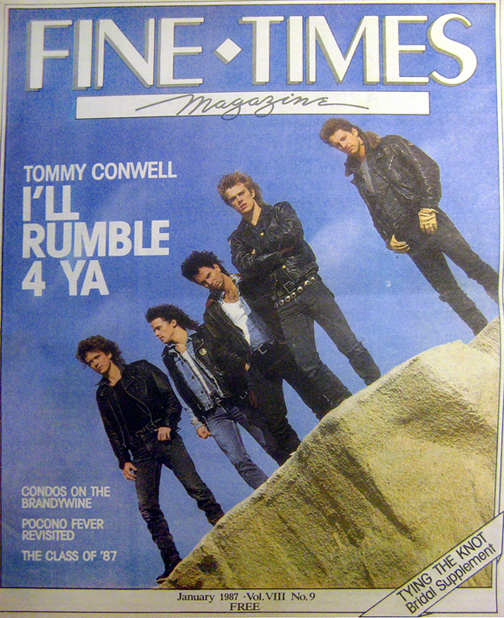
I’ll Rumble 4 Ya!
Two new band members and a debut LP bring the Young Rumblers to the brink of local stardom
By Kate Cericola
Fine Times Magazine, January 1987
Walking on the Water
Looking down on the crowd at Scandal’s, Tommy Conwell and the Young Rumblers can barely see anything beyond the waving mass of hands. Perhaps there’s a babe or two licking her lips in wanton earnest, eyes glued to the huge Guild that protrudes from the rather scrawny guy in the larger-than-life leather jacket, but Tommy Conwell is kind of busy right now.
The amplifiers in the tiny club, off the main strip in Ocean City, are cranked to 11 (that’s one louder than 10), forcing each driving beat of Jim Hannum’s bass drum to gently fan the hair on every head within three feet of the speakers. Paul Slivka’s ubiquitous bass line guides the ruckus at a full-throttle velocity that keeps everyone on the floor jumping like a pack of rowdy Young Rumblers.
Conwell dips the neck of his guitar into the crowd, chains dangling from his wrist, sweat dripping onto the hands that reach up, attempting to capture some of the magic that seems to flow from the body onstage. With Conwell’s arms slung around this old comrade, and the name “Steve Jones” etched in the wood above the E-string are barely discernible.
Conwell returns to his mike, his whole body moving in synch with the right hand that drives his rhythm, as his raunchy rock ‘n’ roll voice kicks the words, “I want to smoke cigarettes and drink too much” into the mob. “But I believe in miracles, but do you believe in me? Let’s go walkin’, walkin’ on the water…”
His only fault is easily forgiven. He suffers from the incurable Musicians’ Curse: the ugly jamming face. With the combination of the hair, sprayed upward into stiletto-esque points, and the facial contortions, Conwell could almost pass for Billy Idol.
The tough-guy boots leave the stage, Conwell lands on the floor of the bar, and he goes walkin’. On a platform amidst the dancers, he plays the hulking instrument behind his head, as his hair falls limp with the weight of his perspiration. Wrenching noises spew from his amp. Sure it’s loud, but that’s rock ‘n’ roll. And while crowd-walking is the oldest trick in the book, the fans like it well enough.
The guitarist seems relaxed – somewhere deep inside him a voice is saying he never really has to return to the stage, but he does. He likes getting down ‘n’ dirty with the audience. He wants to be involved, where the action is – with the babes. But it’s got to end sometime.
Tonight they will take no prisoners. Arming themselves with grinding raw energy and a handful of rock ‘n’ roll tones, they will beat their audience into submission. But when the Rumblers leave the stage, the patrons will hunger for more.
It’s not a bad gig for this little bunch of ruffians. After all, they’ve only been together for two-and-a-half years. In that time, they’ve risen to the top of the local band heap – even opening for established recording artists and playing stages (the Mann, the Tower, and JFK Stadium) many local bands will only experience from a seat in the audience. With their first album, Walkin’ on the Water, in area stores, they seem destined to follow in the footsteps of their older siblings, the Hooters.
Everything They Say Is True
Like his music, Tommy Conwell lets his rough edges show. When he’s not onstage, you’ll still find him in that leather jacket – worn, old comfortable. His blond hair still juts toward the sky, but rather than stiff it seems soft, as if it’s kept up there by the residue of shows gone by. The boots are missing – he sports a pair of old sneakers.
His concerns are simple: his music, his responsibilities to Cornerstone, and a worry that his longer hair in the latest batch of publicity pictures makes him look like Daryl Hall. He’s a bit aloof, perhaps even cocky, but occasionally his comments warrant shy laughter from the rising star.
Although he’s 24, Conwell was still an infant as recently as two years ago, according to manager Steve Mountain. “That was the great part,” Mountain says, “because he’s always been tuned in. He never learned any of those bad habits that you’ll find with bands who have been together longer.”
Almost from the start, Cornerstone has been there to hold the hands of the Young Rumblers, who were willing to learn everything their management could teach them. And while two-and-a-half years more seem like a short time to some, the first Rumblers album has been anticipated for more than a year.
The first thing Conwell learned was how to be a musician rather than a manager. “I’ve always considered myself a leader,” Conwell says. “I guess when everyone else was standing around looking stupid, I would just make a decision.” Before Cornerstone, Conwell booked gigs, drove the truck, set up and collected the money at the end of the night. Since Cornerstone now handles all this and more, Conwell has only his writing and performing to be concerned with.
“I feel I can have faith in them,” Conwell says. “I don’t have to be looking over their shoulder all the time thinking “OK, when are you guys going to screw up?”, which I’ve heard a lot of people do. I’ve heard a lot of horror stories about managers, and I have yet to see any of that.”
Next, Conwell began taking voice lessons in New York and more recently a class in performance, whose graduates include Cyndi Lauper and the Hooters.
His biggest challenge, he says, is writing. “That’s about having faith in yourself. It’s the biggest test of self-confidence because you’re being vulnerable and you’re setting yourself up to be knocked down.”
His lyrics are straightforward, rebellious: “I’m not your man, ‘cause you’re looking for a hero/Baby, it ain’t me.” He claims they don’t have to be meaningful, universal, or world-conscious. They can be, but for now they’re just things that are important to him.
“I’m like music for the less discriminating palate,” he says. “My music is not always so clever or calculating. You don’t have to be in tune to what’s happening to dig the Rumblers. If you like that raw energy, that spark…”
Although they were originally dubbed a “rockabilly band,” perhaps because they were a three-piece with a hollow-body guitar, Conwell finds the notion ridiculous. “I consider us more of a blues band than rockabilly,” he says. Those blues influences give the Rumblers their flair, allowing Conwell to play off his audiences and improvise.
“I like rock ‘n’ roll,” Conwell says. “Some places you go, they call heavy metal ‘rock ‘n’ roll.’ Like ‘We like rock ‘n’ roll…like Iron Maiden.’” He laughs. “Rock ‘n’ roll to me is screaming – like Gene Vincent or ‘Come Go With Me’ by the Del Vikings. That’s fun.
“I like the spontaneity and the rough edges. It’s vital to have some mistakes. That just proves that there are human beings playing. I never liked music that didn’t sound like a band – Tears for Fears or Eurythmics. It sounds like a Pepsi commercial! Pop is fine – Hall and Oates or A-Ha. But I can’t do it.”
Million Pretty Girls
It was Halloween [1986], and the Stone Balloon was hopping when Tommy Conwell and the Young Rumblers took the stage. They bounced around with the same enthusiasm, but there was something different. Gone were the rugged looks of street punks. Well, they still had the same sharp-looking hair, but their leather jackets and boots were missing. Instead, the boys were wearing house dresses shang-haied from Good Will.
“We aren’t girls,” Conwell insists, “we were just wearing dresses.”
Beneath the giant guitar, Conwell’s little white knees stuck out as he rocked the bar. Even the crew were wearing dresses, and Conwell and the Rumblers repeatedly tried to force them onstage by knocking things over.
The crowd was loving it, as usual. A few girls may even have caught a peak up a Rumbler dress if they were lucky.
“Girls are funny,” Conwell says. “Sometimes someone wants to punch you out because their girlfriend likes you, which is hysterical, because you couldn’t give a shit about their girlfriend and she’s all googly-eyed over you.” How he handles the situation: “Bouncer! Management You’re pretty protected. Plus you’ve got all those friends in the audience. I’ve always had more people for me than against me…maybe I’m wrong.” He laughs.
“I’m not trying to make fools out of these girls,” he says, “but it’s interesting for us because we’re just your average guys.”
Do You Still Believe in Me?
To the ear of a true Rumbler fan, Walkin' on the Water, co-produced by Conwell and Hooters bassist Andy King, may seem like a slap in the face. For the price of the nine-track, 12-inch vinyl disc, one will find added keyboard patterns wandering behind the customary rock of the Rumblers. The rockabilly stigma has become obsolete, with the recent additions of guitarist Chris Day (formerly of the John Alexander Band) and keyboardist (and ex-Hooter) Rob Miller.
Conwell is confident that any shock will subside. “I got a lot of resistance from the other guys in the band,” Conwell says of the keyboards. “There was a fear that ‘Wow, we’re not the Rumblers anymore.’ And we’re not – we’re the new Rumblers, so screw the old Rumblers. Rest in peace, it’s been nice knowing you. If the old Rumblers hung around for another two-and-a-half years, I don’t think I’d like them that much. I think I’ve had about enough of that crap. It was really great, but it’s like anything. It gets old after a while.
“We were always three guys trying to sound like six guys, and sometimes it showed in our energy. There’s something novel about that. Now we’ve got the new guys, so we don’t have to sound like six guys. We can just relax.
At some point you have to think about consistency in your sound and your music,” he continues. “Not that you have to think about it, but somehow, when you’re straying too far off the mark, you know it. Like when you bring in a tune that you wrote, and it starts sounding like ELP [Emerson, Lake and Palmer] or some crap, then you know you’ve gone a little too far.”
This was not a problem when turning the Rumblers into a five-piece band. “I knew I was doing the right thing,” Conwell says. “I didn’t care what the other guys thought because I’m the one who’s going to have to live and die with it.”
Bringing the new Rumblers together was no easy task. Conwell, who for fun takes busman’s holidays to see live bands, searched for a year before he found the right players. He admits to watching other bands, all the while pondering who he might be able to steal. Just prior to recording Walkin' on the Water, Day and Miller were inducted into the Rumblers.
Miller was originally auditioned for guitar, but Conwell laughs “he was probably too good for that, so we stuck him on keyboards so he wouldn’t make me look silly.”
For the new songs on the album, Conwell was lucky enough to collaborate with local hitmakers Eric Bazilian, Rob Hyman, and Robert Hazard (Bazilian and Hyman receive no songwriting credits, although they helped write a bridge for “Walkin' on the Water”).
Next, Conwell spent a week in hiding with Andy King at a house in West Virginia. They wrote “Here I Come” and arranged a few new versions of old songs. Conwell says he feels he and King are “old battlemates” after living with him for a week and working together in the studio.
“He understands what I’m trying to do musically,” Conwell says. “He didn’t try to force anything down my throat. I’ve been told producers can change your sound, and that would scare the shit out of me. But Andy didn’t want to change our sound, he just wanted to capture it.”
The Rumblers spent October and November working 12-hour days at Studio 4 in Philadelphia. While the studio environment has a tendency to make less-seasoned musicians choke, Conwell says for the Rumblers it was simply a matter of control.
“You have to remember what you’re doing,” he says. “Most people feel pressurized because they’re putting out money and it’s a one-shot deal. Live performance is a one-shot deal, too – it’s just easier to forget.
“A lot of times when I was recording, I would just imagine all the people in front of me…especially the girls,” he laughs.
I’m Home
Robert Palmer was waiting for the opening act to finish their set at the Mann Music Center. Onstage, three little guys were trying to make themselves sound like six. Not that the audience could tell – they all sat in their designated seats watching the Rumblers strut their finery. It can all be very intimidating, but not for the Rumblers. They’re comfortable – they’re home.
“You get onstage because it puts you in a position to give to people, not to receive.” Conwell says. Playing the bigger stages is easier for the band because they don’t have to work as hard to gain the audience’s attention. At clubs, it’s different – people are drinking, guys and girls are trying to pick up or be picked up, everybody is walking around. At the Mann there are no distractions; the Rumblers won’t have to jump off their amps to say hello. Occasionally there’s some crowd-walking; but not too often. Conwell laughs, “You don’t want to blow away the headliner, you know?”
The best moments are still in the clubs, though: a great night with an eager crowd, playing their favorite tunes with magic flowing from Conwell’s fingertips to the strings of his Guild.
“That’s what it’s all about,” he affirms.” And if there’s a mistake, tough shit. It’s flowing through you. That’s what qualifies me to be so lucky. My job is to let magic flow through me, to express energy, and feel it.
“Sometimes I walk around like Mr. Humble, thinking we’re just a lucky bunch of guys. But when a door is opened for you, you have to walk through. And we’re a band who walks through doors. If I seem confident, it’s because we waited two-and-a-half years to make this album, and I’m glad because I like it. And I wouldn’t say it if it wasn’t true…”
He laughs again. “Well, maybe I would.”