Saturday, March 26, 2011

Connected: Or How We Should All Just Mind Our Own Business and Listen to Cheap Trick

The following is a research article for my grad student program at UT-Dallas in Emerging Media and Communications. The research speaks on the influence of others on activities and their actions around us. I made it fun and talked about Cheap Trick.

     In the case of the book "Connected," by Nicholas A. Christakis, MD, PhD and James H. Fowler, PhD, it appears that we, the people, at least scientifically speaking, cannot help but be influenced by the people surrounding us and the activities of people that flurry around us. For Chapter One’s [In the Thick of It] grim description of a series of family-connected murders in the Mediterranean, I even drew out a graph to keep up with the connections of who went after who and why.
     In the study of network science and theory, Christakis and Fowler take on what seems an almost common sense approach to their revelations, which makes the book an easy read. I was even curious about some of the research items that were on the jacket cover. For example, “You will never date your ex-partner’s current partner’s ex.”
     For some reason, I was thinking that singer Shania Twain had actually broken some unwritten human code, because she recently completed that task (divorcing her ex-husband and then marrying that same ex-husband's best friend) – but the authors brought this question (p.99) about in the context of high school relationships, not multi-million dollar celebrities in their 40's.

     As such, the study of network science and theory takes a simple question, and attempts to answer with, again, results that seem to be common sense answers. For example, take the question that I saw on Twitter the other day:

@hearitlive A buddies older brother turned me on to Cheap Trick when I was 9 - i thought he was pretty cool. Does that still happen?


     So the way that we listen to music now...is it the same way that we used to listen to music and DOES that kind of activity (older kids influencing younger kids) even happen anymore?
     I think it’s a legitimate question. Kids used to have turntables in their rooms and big 12” x 12” works of art [that held the LP] to look at while listening to their favorite bands play their favorite song, lyrics usually included with the LP cover sheet. Younger brothers and sisters and the friends of the younger brothers and sisters would sneak into that bedroom and find albums that they were not listening to or had never heard of, exposing them to a different music style or band that they never would have heard about on their own. A pre-teen might hear The Doors for the first time, and because they were so much younger than the teenager, would be even that much more influenced by the experience of hearing this band's music.

   Today, everyone is rockin’ the earbuds. Not many people I know buy CD’s. And although there has been a slight resurgence in discovering music on LP’s and people enjoying the experience of hearing music on a turntable. In Dallas,  Half-Price Books usually has a good stream of young adults checking out their LP section most weekends. It seems like the music experience, aside from attending a concert or commenting on the latest episode of American Idol on Twitter, has trending towards becoming a solitary experience.
     And because there seems to be such an over-saturation of the market, in terms of avenues and modes of availability in which you can access different types and styles of music (streaming, iTunes, used CDs, SoundCloud, bootleg) -- and not just 'The Hits' -- the way that young kids are even exposed to new (or even old) bands changes every day. The authors might agree.
     Therefore, I think that Connected can shed light on a lot of questions such as:

  • Why certain musical acts don’t get into the Rock n Roll Hall of Fame? 
  • How diseases and/or contagions spread through certain communities and not others?
     Connected was written in 2009 and already some statistics have changed. For example, the average user on Facebook now has 130 friends, not 110.
     This number is still below of what the author's discuss as Dunbar's theory (p. 248) - 150 being the the limit as to which humans have the ability to recognize, monitor and assess other people within their network without being overwhelmed by not knowing who is who, friendly vs. hostile, etc.
     One interesting aspect of of this theory is that modern armies have remained small even to this day, "...suggest[ing] that communication is not the crucial factor. More important is the human mind's ability to track social relationships, to form mental network maps that track who is connected to whom and how strong or weak, cooperative or aggressive, those relationships are."
     As the authors discuss the Internet and its impact on social relationships, they discuss how e-mail was the earliest versions of our online social networking ability. And just as e-mail was condensed so that one e-mail address came to represent one identity, so too will we soon have one profile that "allows one to traverse many virtual worlds and social networks." (p.274) However, we may be required to share our friends on Facebook, but I can still choose to participate minimally.
     As the number of our online social circle grows past what we can truly feel comfortable controlling, will people begin to segment their interests into different personalities and/or profiles? How much will this compartmentalization change the value structure of the identity represented?  

Wednesday, March 9, 2011

"You Can't Sit Down" with Tommy Conwell, Hooters


Courtesy of the Philadelphia Enquirer:
Author: Michael Klein [3/6/2011]
Friday afternoon saw a gathering of Hooters and other rock-and-rollers at Elm Street Studio in Conshohocken to remake the Dovells' hit "You Can't Sit Down." Standing up for the creative process were Eric Bazilian, Graham Alexander (who plays Paul McCartney in Rain on Broadway), Rob Hyman, Tommy Conwell, David Uosikkinen, Jay Davidson, and Jerry Blavat (characteristically ad-libbing). The single, part of Uosikkinen's project known as In the Pocket: Essential Songs of Philadelphia, will be available for downloading next month at songsinthepocket.com. A portion of the proceeds will benefit Settlement Music Schools.

Monday, February 7, 2011

Tommy Conwell and the Young Rumblers perform "Back in the USA" - 1989


Tommy Conwell and the Young Rumblers perform cover of Chuck Berry's "Back in the USA" at the Pennsylvania State Fair, in Bensalem, PA, Memorial Day 1989.

Thursday, January 20, 2011

Tommy Conwell and the Young Rumblers on iTunes


Tommy Conwell and the Young Rumblers. Now on iTunes! At long last!
          Also, don't forget that you can still purchase music and other great items at the 
Tommy Conwell Store...

Saturday, January 15, 2011

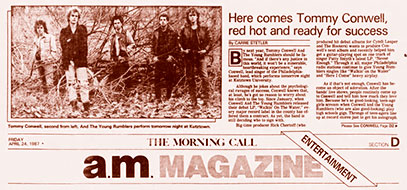
Here Comes Tommy Conwell, Red Hot and Ready for Success [1987]

Here Comes Tommy Conwell, Red Hot and Ready for Success

By Carrie Stetler and The Morning Call
April 24, 1987

By next year, Tommy Conwell and the Young Rumblers should be famous. "And if there's any justice in this world, it won't be a miserable, heartbreaking experience," says Conwell, lead singer of the Philadelphia-based band, which performs tomorrow night at Kutztown University. 

Although he jokes about the psychological ravages of success, Conwell knows that, at least, he's got no reason to worry about his climb to the top. Since January, when Conwell and the Young Rumblers released their debut LP, "Walkin' On The Water," every major record label in the county has offered them a contract. As yet, the band is still deciding who to sign with.

Big-time producer Rick Chertoff (who produced hit debut albums for Cyndi Lauper and The Hooters) wants to produce Conwell's next album and recently helped him get a guitar-playing spot on one track of singer Patty Smyth's latest LP, "Never Enough." Through it all, major Philadelphia radio stations continue to give Young Rumblers singles like "Walkin' on the Water" and "Here I Come" heavy airplay.

As if that's not enough, Conwell has become an object of adoration. After the bands' live shows, people routinely come up to Conwell and tell him how much they love him. Because he's so good-looking, teen-age girls scream when Conwell and the Young Rumblers (who are also good-looking) play high school gigs. Throngs of teen-agers line up at record stores just to get his autograph. It's no wonder that Conwell, 25, occasionally worries if he's becoming conceited. " . . . Sometimes it's confusing, like 'Oh jeez, people are telling me I'm great and I don't want to get a big head . . . ' " he confessed during a recent telephone interview. 

Stardom, possible stardom, even local stardom, can make some people selfish and amoral. Conwell, however, has adjusted to it well enough to remain a nice, slightly introspective guy. This not only makes him a pleasantly honest telephone interviewee; it makes him the kind of of rock star women like for being "sensitive." 

The lyrics to Conwell's love songs are tenderly direct and sincere; so is his aching, throaty delivery. "Take my hand/ Take your turn/ Love's on fire/ But it won't burn," he sings reassuringly during the chorus to "Love's on Fire." On another song, Conwell insecurely asks a girl he's broken up with: "Do you still believe in me?" Add to these sentiments catchy melodies and plaintive guitar hooks and you have the stuff romantic bubblegum music is made of. "I write best when I'm in love," Conwell admits. " . . . I need someone to write to. I'm not an angry writer; I'm not an angry person. I think I stuff my anger somewhere so I don't have to deal with it." 

Don't be misled by such gentleness, however. Conwell doesn't consider himself a future centerfold for Tigerbeat, the teen fanzine. He wants to appeal to both sexes and all age groups, and believes that so far he's pretty much succeeded. 

"I don't think our band would ever woo kiddie magazines," Conwell says, reflecting upon the nature of upcoming Tommy Conwell and the Young Rumblers publicity. 

". . . I don't want people (at our live shows) to scream because I'm wearing tight pants; I don't necessarily want them to scream. They can do what they want, as long as they like the music, that's alright with me . . . I wouldn't want to be like Bruce Hornsby and have all my fans over 30, but I wouldn't want to be like a-ha or Duran Duran either." 

Although they're certainly cuter and dreamier than Duran Duran's Simon Le Bon (though perhaps not as cute as Nick Rhodes), Conwell and the Young Rumblers are diverse and skillful rockers, too. Their live cover versions include everything from 1960s acid rock hits to Roger Miller's country and western crossover classic, "King of the Road." Most of Conwell's fast songs have a blues-rock edge, and he's no slouch on the guitar. He is, in fact, a serious musician. As a University of Delaware student he performed in a punk band, a pop combo, a jazz quartet, and a blues band, all at the same time. "Needless to say, I wasn't on the dean's list, but I had hell of a lot of fun," Conwell recalls fondly. 

A native of Bala Cynwyd, Montgomery County, Conwell founded the Young Rumblers "on Feb. 24, 1984." The present lineup is composed of members that Conwell met in and around the Philadelphia area: bassist Paul Slivka, drummer Jim Hannum, guitarist Chris Day and keyboardist Rob Miller (a former Hooters member). Despite an awkward beginning ("Plenty of people are surprised that we lasted for even a year," Conwell says), the band quickly became The Next Big Thing. 

In the last few months, people have been telling them that any day now, they will be famous rock stars. Conwell thinks he can handle it when and if the time comes because he and the band have worked hard for their success: playing six nights a week, driving themselves to obscure venues in small Pennsylvania towns, taking performance classes and singing lessons, and constantly trying to improve their songwriting and musicianship. 

"Now if we do have whatever success we're gonna have in the future, I'm not going to feel guilty." Conwell says evenly. "I'm not going to feel confused about it and I'm not going to feel uncomfortable. And when someone comes up and tells me 'Hey, we love you,' which they do sometimes, I don't have to say 'Aw schucks, get out of here.' I can just say thank you and not get weird about it. I can just take it for what it is." 

Tommy Conwell and the Young Rumblers perform at 8 p.m. tomorrow at Keystone Hall, Kutztown University, Kutztown. Tickets are available at Ticketron, the usual area ticket outlets and are expected to be available at the door. The concert is presented by Makoul Productions. For information, call 821-0906. 

Carrie Stetler is a free-lance writer on entertainment for The Morning Call.